Student Desk and Chair Design for Schools, Colleges & Training Centers

Students sit at their desks for 6 to 8 hours every day. This long sitting happens during important years of growth when postural habits and musculoskeletal patterns are set. However, most schools approach student furniture like any other procurement, with the lowest bidder winning and comfort not being a factor.
I've been making student desks for schools in Delhi NCR for Geeken for 35 years. I've seen the effects: students who are easily distracted, complaints of chronic discomfort, and posture problems that show up in adulthood. The link between furniture design and learning outcomes isn't just a guess; it's been proven biomechanically.
The Ergonomic Foundation: What Makes Student Desks Effective
Effective student desk for school designs address anthropometric diversity. A single desk that is always the same height cannot properly serve kids who are 4'2" to 6'0" tall in the same classroom.
To be properly ergonomic, student desks must have:
Adjustable Height
This lets students of varying heights lay their feet flat and their thighs parallel to the floor, which keeps their spines in the right position. Fixed-height furniture makes bodies adjust, which causes strain.
Appropriate Surface Angle
Traditional flat surfaces make you bend your neck to read and write. Slight surface angles (5–10 degrees) help keep the neck in a neutral position, which reduces strain.
Adequate Leg Clearance
Not enough space under student desks for schools makes it hard to move around and uncomfortable to sit for long periods of time.
Storage Integration
Bag hooks, book compartments, and other storage solutions keep the floor clear of clutter that can be a safety hazard and a distraction.
As student desk dealers in Gurgaon, we've supplied hundreds of schools. Institutions that buy adjustable furniture say that it helps students focus better and stop fidgeting.
The Training Center Requirement: Adult Learners
Training chairs for students in corporate and vocational settings have different needs than school furniture. Adult learners go to multi-hour sessions, frequently after a full day of work, so they need furniture that is more comfortable without losing focus.
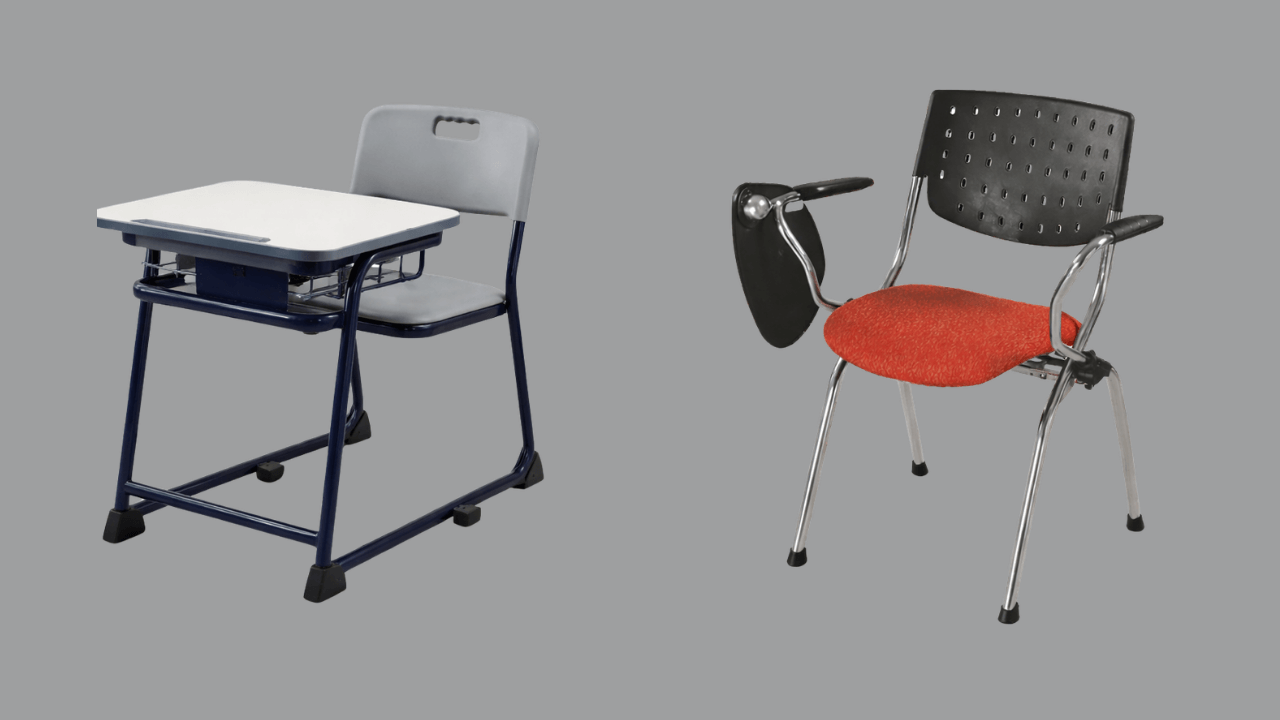
Features include:
Tablet Arm Desks that combine seating and writing surfaces to make the most of the space
Stacking Capability: This lets you quickly change the layout of a space for different types of training
More padding: Lets you sit for 2 to 4 hours without becoming uncomfortable
Mobility: The chairs have wheels or are light enough for people to move them around for group activities
We just put 80 training chairs for students in a corporate training center in Gurgaon. The client specifically asked for furniture that could be used for both lecture-style and interactive workshop setups. Our modular design made it possible to completely change the room in less than 10 minutes, from theater seating (80 people facing front) to collaborative clusters (8 groups of 10) to examination layout (individual spacing).
This flexibility made the most of the space and made the training more effective.
The Budget Reality: Quality vs. Cost
Educational institutions operate under budget constraints. Administrators are under pressure to buy the cheapest furniture. But when you look at the whole cost of ownership, you may see that high-quality furniture is a better deal.
Budget Furniture Lifecycle:
Cost per student desk for school: ₹3,000
4 to 5 years between replacements
Total for 15 years: ₹9,000–₹11,250 (original plus 2–3 replacements)
Quality Furniture Lifecycle:
Cost at first: ₹6,500 per desk
Time between replacements: 12 to 15 years
Total for 15 years: ₹6,500
The math favors quality investment,saving 40–45% across institutional planning horizons.
Quality furniture also offers:
Lower costs for upkeep
Less complaints from students
Better reputation for the institution
Better results in learning
Geeken's Educational Furniture Philosophy
After 35 years as student desk manufacturers in Delhi NCR, we learned that making educational furniture isn't just making things,it's investing in learning infrastructure.
We provide:
Anthropometric Research: Designs based on Indian student body measurements, not Western standards
Testing for durability: Testing that mimics how institutions would use the product
Customization Capability: Changing sizes, colors, and features to meet the needs of a given institution
Installation Support: Professional installation that makes sure everything is put together and adjusted correctly
This all-encompassing approach sets us apart from other student furniture suppliers in Delhi NCR.
FAQs
Q1: What's the best height for student desks for different age groups?
Students' feet should be able to rest flat on the floor with their thighs parallel to the floor. For kids in grades 1–5 (ages 6–10), the size is 20–24 inches. For kids in middle school (ages 11 to 14), it's 24 to 27 inches. For college and high school, 28 to 30 inches. Adjustable-height desks are great for classrooms with kids of different ages or for kids who are growing.
Q2: How much should schools spend on good classroom equipment per student?
Plan on spending between ₹5,500 and ₹8,000 for each student for a desk and chair set. This includes furniture that is strong, comfortable, and lasts 10 to 12 years. When you have less money, you have to give up some adjustability and durability. More expensive desks (₹10,000+) include more advanced features, such as the ability to connect to technology and use high-quality materials.
Q3: What is the difference between desks for school students and furniture for training centers?
School desks are built to last, make room for growth, and hold things. The furniture in training centers is designed to be comfortable for adults, flexible, and space-efficient. Training chairs frequently include tablet arms, the capacity to stack, and extra padding for sessions that last 2 to 4 hours. School furniture is made to last for 6 to 8 hours of use every day by kids who are growing.
Copyright ©2026 Geeken. All Rights Reserved.